
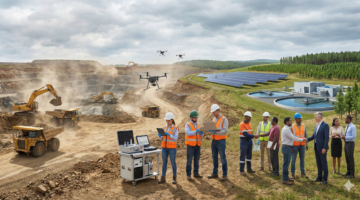
Gold has captivated humanity for thousands of years. From ancient civilizations that worshipped it as a symbol of divine power to modern financial systems that use it as a global reserve asset, few materials have shaped human history quite like gold. Today, the industry that brings this precious metal from the earth to the world economy is undergoing one of its most significant transformations in history — driven by technological advancement, environmental awareness, and a growing demand for ethical sourcing.
The Scale of the Global Gold Industry
Gold mining is a truly global enterprise. Every year, the world produces roughly 3,000 to 3,500 tonnes of gold, extracted from mines on every inhabited continent. The industry supports millions of jobs directly and indirectly, contributes billions to national economies, and underpins a significant portion of the world's financial reserves.
But gold's importance extends well beyond jewelry and investment. The metal is a critical component in electronics, aerospace technology, medical devices, and renewable energy systems. As the world becomes more technologically advanced, demand for gold — reliable, conductive, and corrosion-resistant — shows no signs of slowing down.
How Gold Is Mined: From Exploration to Extraction
The journey of gold from deep within the earth to a finished product is long, complex, and capital-intensive. It begins with exploration — geologists survey vast tracts of land using satellite imagery, geochemical sampling, and drilling to identify deposits worth developing. This phase alone can take years and require substantial investment before a single ounce is produced.
Once a viable deposit is confirmed, the development phase begins. Infrastructure must be built, environmental impact assessments conducted, and regulatory approvals secured. Only then can extraction begin in earnest.
Modern gold mining relies on two primary methods. Open-pit mining is used when deposits are close to the surface, involving the removal of large quantities of rock and soil to expose the ore beneath. Underground mining, on the other hand, is employed when deposits lie deep below the surface, requiring the construction of shafts and tunnels to reach the ore body. Each method carries its own technical demands, cost structures, and environmental considerations.
The Environmental Imperative
There is no avoiding the fact that mining — any mining — has an environmental footprint. Land is disturbed, water resources are affected, and energy is consumed at significant scale. For decades, parts of the industry operated with little regard for these impacts, leaving behind scarred landscapes and contaminated water sources.
That era is coming to an end. Today's most forward-thinking mining companies are investing heavily in technologies and practices designed to minimize environmental damage — from water recycling systems and tailings management to land rehabilitation programs that restore mined areas to productive ecosystems after operations conclude.
The industry is also under increasing scrutiny from investors, governments, and the public. ESG (Environmental, Social, and Governance) standards have moved from the margins to the mainstream, and companies that fail to meet them face real financial and reputational consequences. For responsible operators, this is not a burden — it is an opportunity to differentiate and lead.
The Human Side of Gold Mining
Behind every ounce of gold is a workforce of miners, engineers, geologists, logistics professionals, and community members whose lives are shaped by the industry. At its best, gold mining can be a powerful engine of economic development — creating well-paying jobs, funding public infrastructure, and transferring technical skills to local communities.
At its worst, however, the industry has been associated with unsafe working conditions, displacement of indigenous communities, and inequitable distribution of profits. The concept of artisanal and small-scale mining (ASM) adds another layer of complexity: millions of people worldwide mine gold informally, often without access to safety equipment, fair markets, or legal protections.
Addressing these human dimensions is not optional for a responsible mining company — it is central to the license to operate.
Technology: The Next Frontier in Gold Mining
Innovation is reshaping the gold mining industry at an unprecedented pace. Automation and robotics are improving safety and efficiency in underground operations. Artificial intelligence is being used to analyze geological data and identify high-value ore deposits faster and more accurately than ever before. Drone technology enables rapid aerial surveying of remote terrain, cutting exploration costs dramatically.
On the processing side, advances in bioleaching and other hydrometallurgical techniques are allowing miners to recover gold from lower-grade ores that were previously uneconomical to process — effectively unlocking reserves that once seemed out of reach.
Perhaps most significantly, the push for greener energy is transforming the power mix at mine sites. Solar, wind, and battery storage systems are increasingly replacing diesel generators, reducing both carbon emissions and operating costs.
The Role of Gold Trading in the Global Supply Chain
Mining is only one part of the gold supply chain. Once extracted and processed into doré bars or concentrate, gold must be refined, certified, and traded — moving through a complex global network of refiners, banks, bullion dealers, and end users.
Transparency in this trading process is critical. Gold has historically been vulnerable to illegal flows, conflict financing, and money laundering. International frameworks such as the London Bullion Market Association (LBMA) Responsible Gold Guidance and the OECD Due Diligence Guidance have established standards that responsible operators are expected to meet — ensuring that the gold entering the global market is ethically sourced and fully traceable.
Companies that integrate mining and trading operations under a single, accountable structure are uniquely positioned to guarantee this kind of end-to-end transparency.
What Responsible Gold Mining Looks Like
The gold mining industry is at a crossroads. The choices made by companies, governments, and investors over the next decade will determine whether the industry becomes a force for sustainable development — or continues to carry the reputational and environmental baggage of its past.
Responsible gold mining means committing to safety as a non-negotiable standard. It means engaging honestly with communities, sharing benefits equitably, and leaving places better than you found them. It means embracing innovation not just for efficiency, but for sustainability. And it means maintaining transparency at every step of the supply chain, from the mine face to the market.
This is the standard that the best companies in the industry are working toward — and the benchmark against which all others will increasingly be judged.
Goldinberg's Commitment
At Goldinberg, these principles are not aspirational — they are operational. With an integrated mine-to-market model, a deep commitment to community empowerment, and an unwavering focus on ethical excellence, Goldinberg is working to demonstrate that gold can be mined and traded in a way that creates lasting value for all stakeholders.
The future of gold mining is responsible, transparent, and innovative. Goldinberg is proud to be part of building it.
Learn more at goldinberg.com